
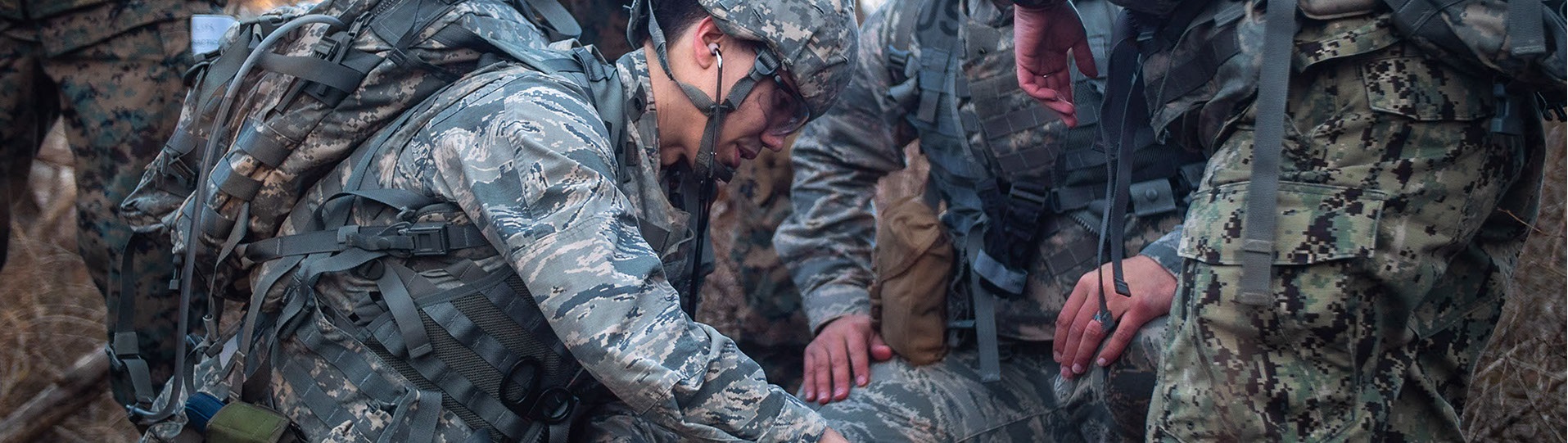
Infections resulting from battlefield trauma, particularly those with multidrug-resistant (MDR) pathogens, not only prolong the recovery of wounded warfighters, but may also be life-threatening or impose serious long-term consequences (e.g., limb loss). Thus, it is vital to use the lessons learned from recent wars to support evidence-based care of casualties during the next conflict.
Analyses conducted through the Wound Infections Research Area are aimed at informing improvements in evidence-based clinical practice guidelines (CPGs) and identifying wound infection prevention and treatment best practices to support frontline readiness. Community-associated skin and soft-tissue infections (SSTIs), primarily caused by Staphylococcus aureus, are also the focus of analyses to inform effective strategies to mitigate their burden on the health of military recruits and limit impacts on operational readiness.
A major achievement in 2025 was the development of the new Military Trauma Infections – Southwest Asia Conflicts Cohort (MTI-SCC) protocol. Led by Dr. David Tribble, and in collaboration with the Department of War (DOW) Joint Trauma System (JTS), MTI-SCC will collect data from military personnel injured in support of military operations in Southwest Asia between 2001 and 2025. Analysis of injured warfighters across theaters and time periods will allow for comprehensive assessment of outcomes with different injuries, wound microbiology, and infection management strategies. Artificial intelligence (AI) and machine learning (ML) methods will be used to identify optimal medical and surgical management approaches to improve outcomes with high-consequence infections (i.e., life-threatening or long-term consequences).
Multiple analyses were also completed through the Trauma Infectious Disease Outcomes Study (TIDOS) and include the evaluation of outcomes of penetrating traumatic brain injuries (TBI) versus closed TBIs and non-head injuries, sepsis and pneumonia following battlefield trauma, infectious complications of maxillofacial fractures and burns, and healthcare resource utilization among battlefield casualties. In collaboration with the United Kingdom Ministry of Defence (U.K. MOD), the initial epidemiologic analysis of the TIDOS and U.K. MOD wounded military populations and resulting extremity wound infections (EWIs) was completed. Next steps are comparative analyses to examine outcomes with differing management approaches to support best practices. Analyses focused on wound microbiology were also conducted through the TIDOS MDR and Other Virulent Organisms Trauma Infections Initiative, which is a collaboration with multiple DOW laboratories led by Dr. Katrin Mende. With the mentored assistance of our military Infectious Disease fellows, the epidemiology and antimicrobial resistance characteristics of wound infections with Acinetobacter baumannii and S. aureus were examined with the A. baumannii analysis recognized in a research competition.
Supporting evidence-based CPGs and preparedness for future conflicts are the focus of other TIDOS initiatives. Through the collaboration with the University of Minnesota (UMN) and University of Michigan Medicine (UMich), pooling of military and civilian trauma patient data was completed and analyses to assess outcomes with different post-trauma prophylactic strategies and EWI antimicrobial treatment approaches are underway. In collaboration with the U.S. Army Institute of Surgical Research (USAISR) and U.S. Army’s Telemedicine and Advanced Technology Research Center (TATRC), a ML-based algorithm to provide clinical decision support and to aid prehospital triage with infection risk stratification, particularly with prolonged field care, was developed. Additionally, another ML-based algorithm to provide diagnostic support with enhanced precision following hospital admission is nearing completion.
Another success was the pooling of over a decade’s worth of data and specimens from seven IDCRP protocols, which had assessed community-associated SSTIs in recruit and other congregate military populations into the SSTI Repository Protocol. Although still being analyzed, the preliminary epidemiologic findings were presented at a national conference in 2024. The prospective, observational study of Ukraine war-related wound infections conducted by the University of Colorado in collaboration with the Walter Reed Army Institute of Research, Multidrug-Resistant Organism Repository and Surveillance Network (WRAIR MRSN), and supported by the TIDOS team, also began data collection and analysis.
For 2026, analyses to support evidence-based management and develop ML-based algorithms for frontline clinical decision support will be completed. A Wartime Infection, Control and Prevention Knowledge, Attitudes, and Practices (KAP) Survey to assess the familiarity of frontline providers with combat casualty care and infectious disease guidelines will begin data collection and analysis in the coming year. As part of a wartime preparedness initiative, technical recommendations and scientific/regulatory frameworks will be developed to inform a next-generation JTS DoD Trauma Registry Infectious Disease Module and Wartime Specimen and Isolate Repositories. In collaboration with the George Washington University Biostatistics Center, ‘on-the-shelf’ clinical trial protocols for activation during future conflicts to examine the effectiveness of battlefield wound infection prevention and management strategies and products will be developed and submitted for scientific review. Following data collection and management efforts, the first analyses of the MTI-SCC study population will be initiated to include use of AI and ML methods. Conducting a landscape review and gap analysis related to SSTI prevention in military recruit settings to identify priority research questions and prevention strategies to inform future prospective studies or clinical trials is also planned.
Military Impact
The Wound Infections Research Area is responsive to research priorities, policies, and guidelines of the Defense Health Agency (DHA), JTS, and the MHS, conducting studies to address identified gaps in combat casualty care to support wartime preparedness and inform development of a research infrastructure for future conflicts. In support of EWI evidence-based management, the findings from the UMN/UMich collaboration, combined with the results of a systematic review conducted by the UMN Evidence-Based Practice Center, will be provided to the JTS to help inform whether a consensus panel should be convened to refine existing and develop new CPGs for the prevention and treatment of battlefield-related wound infections. Findings from the University of Colorado Ukraine War-related wound infection study will help inform combat casualty care in future large-scale combat operations. The KAP Survey will potentially identify areas where further training or education regarding combat casualty care are needed. Analyses through the MTI-SCC protocol will inform preventive and treatment approaches for battlefield-related infections to improve combat casualty care.